Every time this song is played that is time the stores playing it could better spend playing “I Want an Alien for Christmas” or “Merry Christmas From Chiron Beta Prime” okay
Androids are my special interest so i’ve been following discussion about them and development of them for almost ten years and I’m stupid passionate about it. If anyone is wondering where we are at in our ethical discussion of robot development, this is whats going on.
Most of the discussion seems to be between these 5 fields:
Robot makers of all kinds (from animatronics all the way to industrial robotics) Psychologists Sociologists Lawyers/Lawmakers Ethicists
The general consensus has been:
All: Humanity clearly wants these robots and are getting blisteringly close to being able to build them to Chobits level, but not Blade Runner level, so while we have some free time between those phases lets talk about potential outcomes.
Psychologists: hem hem. we are concerned about what happens to the way we develop relationships. Humans imprint on things hardcore and because of this we are concerned.
Sociologists: I mean… yeah thats a concern, but its not nearly as concerning as what introducing an entire class of humanoid beings without rights to a society where real living people dont have rights
Lawyers: speaking of rights, what happens if you kill one. Like. do we call it “kill” or is it “break?” can you kill something that’s technically not alive??? what if you rape it?? Can you rape a robot? I feel lawsuits coming and its making me itchy.
Robot Makers: Everyone calm down. They’re just objects, they’re toys. Its chill.. See, we’ll make something like it and see what hap–they broke it. they fuckin destroyed it. They destroyed it in a creepy way too….We are now also concerned.
Psychologists: Maybe we should be less concerned about people falling in love with robots and more concerned about what all this might do to their understanding of the disposability of concent and personhood.
Sociologists: YEAH MAYBE YOU SHOULD BE, PSYCHOLOGIST.
Ethicist: While you were all talking I’ve been thinking about what Lawyer said about raping a robot. While technically it wouldn’t be “rape” by our laws, would the robot perceive it that way? Do robots have concepts of justice?
Robot Makers: They don’t if we don’t program it into them. See I’ll just make this prototype and–wow. it can comprehend fairness and concern. I only taught it the difference between a safe and unsafe situation under the circumstances of it rolling off a table or not. huh. uh. ok…thats. hm.
Lawyers: If it can be concerned for its well being, does that give it personhood? Becuase if its got personhood, its gotta have rights. And if it needs rights, we gotta make laws.
Ethicist: The question is not whether we think it has personhood, but more whether IT considers ITSELF to have personhood. Because historically, people have decided other groups of people dont have personhood regardless of the opinon of individuals within that group and it was bad. Like… real bad.
Sociologist: Does anyone remember what i said 20 years ago about being concerned about introducing an entire class of humanoid beings without rights to a society where real living people don’t have rights? Can we be concerned about that now?
All, chagrined: Yes.
Sociologist: Cool, lets move on. Ethicist brought up an interesting point about personhood and Lawyer brought up an interesting threat about personhood and Robot Maker is having an existential crisis about what it means to become God. So let’s condense our viewpoints and overview potential consequences:
1. we agree that society frames the use and consequences of all products/entities developed in it.
2. personhood is self-defined, and thanks to Robot Maker we now know that adding components to a robot that seem benign can have the added effect of them developing aspects of personhood.
Robot Maker, interrupting: And I think that the more complex the android, the more immediate and complex their understanding of personhood would develop–
Sociologist: Yes, we get that. This is a review. Anyway, 3. When they develop that personhood, they should be eligible for rights??
Lawyer: Get back to us on that, we’re trying to figure out whether this is going to make us a lot of money or just be a giant red-tape headache and you know how much we hate those. But also, if we give them rights they might not kill us all later, so we’re taking that into consideration.
Sociologist: Noted. 4. when they develop personhood, denying them rights is unethical????
Ethicist: Technically yes, but that’s dependant on the definition of personhood within our legal systems ethics. You see Kant believes–
Sociologist:
Psychologist:
Robot Maker: while you guys were talking I made a robot that has opinions, can understand the nuances of humor, can teach itself to walk, and also doesn’t like humans much apparently so can you tALK FASTER PLEASE
And that’s where we’re at now. That was 35-ish years of intracommunity discussion condensed.
C-3PO, but with bad image recognition, just walking around Tatooine with his hands over his eyes being constantly scandalized by the sand dunes because his AI tells him he’s surrounded by an endless expanse of nude flesh.
You ever write up a post you decide will be too controversial or embarrassing but leave it in your drafts to sleep on and then forget about it? How about real personal stuff you weren’t sure you wanted to share at the time? Heavy-ass receipts on bad shit you’re leaving there only just in case you’re forced to use them?
Well if any of your drafts get flagged by the new system, a mod can apparently see them in with all your other flagged posts, and if they un-flag them, it publishes them automatically as a brand new post. MERRY CHRISTMAS!!!!
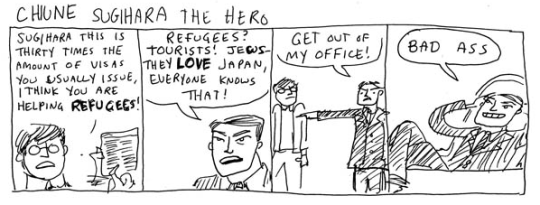
Chiune Sugihara. This man saved 6000 Jews. He was a Japanese diplomat in Lithuania. When the Nazis began rounding up Jews, Sugihara risked his life to start issuing unlawful travel visas to Jews. He hand-wrote them 18 hrs a day. The day his consulate closed and he had to evacuate, witnesses claim he was STILL writing visas and throwing from the train as he pulled away. He saved 6000 lives. The world didn’t know what he’d done until Israel honored him in 1985, the year before he died.
Why can’t we have a movie about him?
He was often called “Sempo”, an alternative reading of the characters of his first name, as that was easier for Westerners to pronounce.
His wife, Yukiko, was also a part of this; she is often credited with suggesting the plan. The Sugihara family was held in a Soviet POW camp for 18 months until the end of the war; within a year of returning home, Sugihara was asked to resign – officially due to downsizing, but most likely because the government disagreed with his actions.
He didn’t simply grant visas – he granted visas against direct orders, after attempting three times to receive permission from the Japanese Foreign Ministry and being turned down each time. He did not “misread” orders; he was in direct violation of them, with the encouragement and support of his wife.
He was honoured as Righteous Among the Nations in 1985, a year before he died in Kamakura; he and his descendants have also been granted permanent Israeli citizenship. He was also posthumously awarded the Life Saving Cross of Lithuania (1993); Commander’s Cross Order of Merit of the Republic of Poland (1996); and the Commander’s Cross with Star of the Order of Polonia Restituta (2007). Though not canonized, some Eastern Orthodox Christians recognize him as a saint.
Sugihara was born in Gifu on the first day of 1900, January 1. He achieved top marks in his schooling; his father wanted him to become a physician, but Sugihara wished to pursue learning English. He deliberately failed the exam by writing only his name and then entered Waseda, where he majored in English. He joined the Foreign Ministry after graduation and worked in the Manchurian Foreign Office in Harbin (where he learned Russian and German; he also converted to the Eastern Orthodox Church during this time). He resigned his post in protest over how the Japanese government treated the local Chinese citizens. He eventually married Yukiko Kikuchi, who would suggest and encourage his acts in Lithuania; they had four sons together. Chiune Sugihara passed away July 31, 1986, at the age of 86. Until her own passing in 2008, Yukiko continued as an ambassador of his legacy.
It is estimated that the Sugiharas saved between 6,000-10,000 Lithuanian and Polish Jewish people.
It’s a tragedy that the Sugiharas aren’t household names. They are among the greatest heroes of WWII. Is it because they were from an Axis Power? Is it because they aren’t European? I don’t know. But I’ve decided to always reblog them when they come across my dash. If I had the money, I would finance a movie about them.
He told an interviewer:
You want to know about my motivation, don’t you? Well. It is the kind of sentiments anyone would have when he actually sees refugees face to face, begging with tears in their eyes. He just cannot help but sympathize with them. Among the refugees were the elderly and women. They were so desperate that they went so far as to kiss my shoes, Yes, I actually witnessed such scenes with my own eyes. Also, I felt at that time, that the Japanese government did not have any uniform opinion in Tokyo. Some Japanese military leaders were just scared because of the pressure from the Nazis; while other officials in the Home Ministry were simply ambivalent.
People in Tokyo were not united. I felt it silly to deal with them. So, I made up my mind not to wait for their reply. I knew that somebody would surely complain about me in the future. But, I myself thought this would be the right thing to do. There is nothing wrong in saving many people’s lives….The spirit of humanity, philanthropy…neighborly friendship…with this spirit, I ventured to do what I did, confronting this most difficult situation—and because of this reason, I went ahead with redoubled courage.
He died in nearly complete obscurity in Japan. His neighbors were shocked when people from all over, including Israeli diplomatic personnel, showed up at quiet little Mr. Sugihara’s funeral.
I will forever reblog this, I wish more people would know about them!
I liked this before when it had way less information. Thank you, history-sharers.
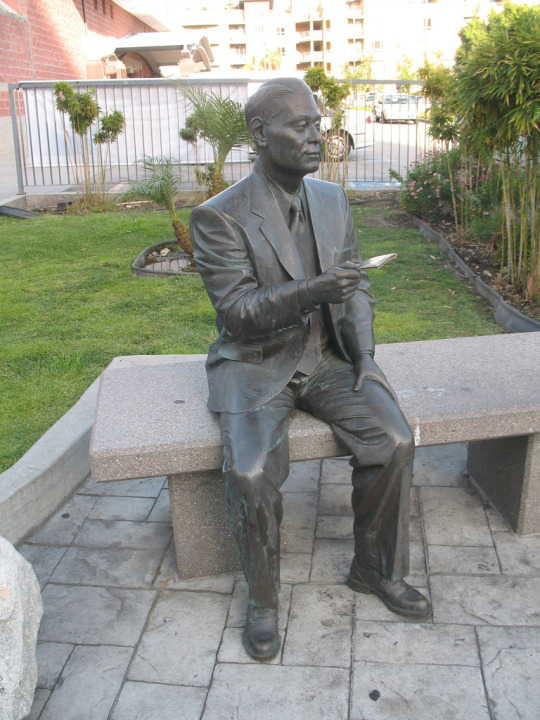
Tucked away in a corner in L.A.’s Little Tokyo is a life-sized statue of Chiune, seated on a bench and smiling gently as he holds out a visa.
The stone next to him bears a quote from the Talmud; “He who saves one life, saves the entire world.”
I had no idea it existed until a few weeks ago, but it’s since become one of my favorite pieces of public art.
Chiune Sugihara. Original antifa.
PBS made a documentary about Chiune Sugihara in 2005. If you’re interested in him, it’s definitely worth checking out. (The PBS link above even has some interactive information to go along with the film.) Ask your local library if they have a copy/can order you one from another library. You won’t be disappointed!


 Monsters and Stuff