Rhythm, pattern, and sound matter more in writing than you may think, but it’s often overshadowed by stress on other elements that make a story pleasant to the mind.
Repetition. This is pretty self-explanatory.
Use of words that don’t fit the situation (Especially in dialogue. If a character is laid back and simple in their speech, they aren’t going to use a word like “demonstrably”).
She nodded. (We know it’s her head and we know a head nod signifies agreement.)”
Bad punctuation. Keep in mind that a period is a stop in speech, while a comma is more of a pause. This can make a massive difference in the way the story flows. Commas are your friends.
Breaks in story. Carefully choose where paragraphs start and end, as well as chapters or scenes. You want the end of each paragraph to hint at a transition into the next.
Pay attention to sentence length. This may not be a shock, but sentence length is one of the most important things to pay attention to when creating flow. Barbara Tuchman, winner of two Pulitzer prizes, has a tip for her readers, in terms of sentence length: 3 long sentences, two short “staccato” sentences. Sentences that are all the same length are boring!
A few highlights from the best article I found on flow which you can find HERE:
“
Action scenes contain few distractions, little description, and limited transitions. Omit or limit character thoughts, especially in the midst of danger or crisis, since during a crisis people focus solely on survival. To create poignancy, forgo long, descriptive passages and choose a few details that serve as emotionally charged props instead.
“ On Action Scenes
“ When the outcome of a scene or chapter is left hanging, the pace naturally picks up because the reader will turn the page to find out what happens next…
If your characters are in the midst of a conversation, end the scene with a revelation, threat, or challenge.
“ On Cliffhangers
“ Reactions, descriptions, and attributions are minimal. Don’t create dialogue exchanges where your characters discuss or ponder.“ On Dialogue
“ Suspense and, by extension, forward movement are created when you prolong outcomes.” On Prolonged Outcomes
“ Summary is a way of trimming your word count and reserving scenes for the major events. You can also summarize whole eras, descriptions, and backstory. Summaries work well when time passes but there is little to report, when an action is repeated or when a significant amount of time has passed.” On Summary
“ Think concrete words (like prodigy and iceberg), active voice (with potent verbs like zigzag and plunder), and sensory information that’s artfully embedded. If you write long, involved paragraphs, try breaking them up.” On Word Choice and Sentence Structure
Sources Used In This Post (A.K.A. where to learn more)
I don’t have much experience with writing scary stuff and I need advice. I’m trying to write a scene similar to the one in Jurassic Park where the kids are dodging the raptors. But I’m having trouble translating the tension and terror in that scene into prose.
Jurassic Park by Michael Crichton is a horror novel. If you haven’t looked at the book yet, I suggest giving it a read. You’ll find more insights into the source of the horror and how to write horror with dinosaurs in the novel than in the movie. The best way to learn about writing horror is to read horror novels. You can also read The Lost World by Michael Crichton, which isn’t a sequel to his first novel but a novelization of Spielberg’s second movie. You might glean some insights there also on the nature of translating visual mediums to the page.
Now, let’s move on to Jurassic Park the film. The raptor sequence is the capstone to the film’s subplot. The emotions you feel while watching this scene have been carefully managed and developed by what we’ve learned about the raptors, what they’re capable of, and what we’ve seen them do to the movie’s adults; including Muldoon, the park’s gamekeeper. Scenes in novels and film aren’t individual pieces which can be broken off. They’re part of a collective whole where all the pieces are working together for that climactic moment. Taking what you like from a book, a television show, or a comic is all well and good, but don’t forget to take your time and figure out how the narrative got there. What were the pieces leading up to this scene with the raptors which foreshadowed and emphasized the danger they represented? In the raptors’ case, the foreshadowing begins with the opening sequence with Muldoon and the workers putting a raptor into the cage. We never see the raptor, but we can hear it. Then, later we see Grant, Ellie, and the little boy at the digsite discussing the raptor skeleton. “You’re still alive when they start to eat you.”
This is all a careful structure on the movie’s part to build audience anticipation, including Grant having this discussion with a little boy rather than an adult. The possibility of the children being eaten in the beginning feeds toward that final scene in the movie.
The problem with looking to film specifically when trying to replicate is the presentation of a scene is visual. You need to look past the camera placement, and delve into the other four senses. The horror of Jurassic Park is a particular subgenre, one should probably familiarize yourself with on a conceptual level.
Your characters being hunted.
This is probably already obvious to you, but think it through. The scene with the raptors in Jurassic Park with the kids involves the children being hunted. With the way the shots are framed, we see both. The raptors are communicating back and forth with each other as they try to problem solve on the location of the children. The kids figure out where the raptors are through the sounds they make, and their reflections in the stainless steel cabinets. The kids need to get past the raptors and make it to the single exit from the room or else game over. The narrative has already established these animals are some of the most highly advanced and intelligent pack hunters to ever exist.
So, how do they escape?
From a written perspective, you don’t want to show the raptors. You don’t want the audience to know where they are because that heightens the tension. We see what the characters see, we hear what they hear, and the tension in a written context largely comes from what we don’t know. Based on what we don’t know, we can’t relax and neither can your characters.
Anyone can die.
You may have already planned it out for how these characters survive, but here’s the thing… you need to forget that they’re going to live and focus on them trying not to die. If you let them relax into the idea that they’re getting out of this because you already know that they are then they won’t try to survive and they’ll cheapen the scene.
Horror is about characters getting picked off one by one until only the few remain. The death count is necessary because it heightens the danger our antagonist represents, but keeping that monster in the unknown is also important. Survival should never be guaranteed. If it’s not, you’ll be focusing on the “problem solving” aspect of your characters, them figuring out under pressure how they’re going to escape this situation, and delve into the necessary “run for your life” aspect.
These characters don’t have the tools they need to fight this monster, all they can do is run. However, if you run from a Jurassic Park raptor then the raptor will run you down. They’re as fast as you, as agile as you, and more clever.
This is the video game stealth sequence where if you fuck up, you die and there’s no reload, no do-over. You’re done. So, knowing that, how do your characters behave while under pressure?
Don’t Be Afraid to Throw Out the Outline
Don’t fool yourself into thinking you need your characters to make the right choices. Don’t munchkin your way to victory. Desperate people don’t really make the right choices, they make choices which feel right to them in the moment and hope they work out.
As a creative, I loosely outline but never make myself beholden to it for the express purpose of making changes. In my first draft, I let my gut dictate where the story goes. This means, sometimes, characters who I wasn’t expecting to die do die and characters I wasn’t planning on having live ultimately survive. This gets cleaned up in later drafts, but this means that my characters are always making snap decisions in the moment. Sometimes, they work out. Sometimes, they don’t. This works well for me as a writing tool, keep in mind that it may not for you, and it’s only one option.
Think from the Perspective of Your Characters
When you watch the raptor scene from Jurassic Park, put yourself into a position where you’re re-imagining the scene from the perspective of the kids. You’re not trying to copy beat for beat. Think about how you would feel when put into a similar situation. What would you do in a similar position, what would the characters you’re writing do? We’re talking about a character being hunted, even an act as simple as sticking their head up to look for the monster can be fatal, where the sound of their breathing is a risk, when any movement could alert the monster to their presence. The kids aren’t skilled at moving without a sound and they’re in a kitchen loaded with opportunities for their hiding spot to be discovered either by a knocked off object or just by touching the thin steel wall of the cabinet.
Do you go left or right? Do you look for the monsters? How do you do this? Do you peer under the cabinets? Try to watch their reflection? Lift your head up? Do you crawl on the floor or run?
You’ve got to make a choice. If you stay in one place, you’ll die.
The raptors are looking for you. You can hear them calling back and forth to each other, but you have no idea what they’re saying. The sound hurts your ears. Your heart is pounding so loudly you’re sure the raptors can hear it. You’ve already seen so many of your friends die. Fall down, trip on the floor, not close a door fast enough, make mistakes, and, ultimately, get eaten. They’re all gone now. There’s no adults around. No one to protect you. There’s just you.
So, what do you do?
Make a dice roll. Hope you succeed.
This is really how you write action/adventure, and how you imitate Spielberg’s work in your writing. You’ve got to bring the scene home to the stakes for survival, the emotions of the characters, and the consequences of failure.
Know Your Horror
Horror thrives on the idea that your characters are ill-equipped to handle the situation, and are out of their element. They’re not perfectly suited to deal with what’s happening to them. If they are, if you present them as hyper competent and supremely capable, then it will kill all of your tension. You want completely average people trying to survive in situations where they are way over their head. The horror monster has to have the advantage, otherwise this isn’t Aliens or Predator. We’re in Aliens versusPredator territory and, whatever else we might say about them, those movies are not horror. Another example is the later Jurassic Park films like Jurassic Park III and Jurassic World which are straight up theme park action adventure, more and more outrageous as the dinosaurs become less and less legitimately dangerous to the health of our protagonists.
You need to be willing to let your characters look silly, weak, fumbling, and incompetent. Normal kids who love books on dinosaurs and computers, who constantly bicker to the point of driving everyone else around them crazy. Kids who cry, kids who whine, and clamp their hands over their mouth to keep from screaming.
Close platonic friendships go through many of the same stages and steps as a romantic relationship, but obviously without the romantic and/or sexual interest. Much like a romance, it can begin with an instant “attraction,” or it can develop slowly over time, but it ultimately builds through a series of shared experiences, common interests, and a building of trust.
The Different Types of Friendship
acquaintances – known but not known well
associate – sharing a common activity such as work or a class
networking contact – friendly acquaintance who is beneficial to know
mentor – acquaintance who imparts knowledge or experience
social friends – friends you socialize with but don’t rely on in any way
good friends – friends you socialize with but can also count on if you need a favor or some light emotional support
close friends – friends you know well, can be yourself around, and can count on for favors and heavy emotional support
confidant – a close friend who you can tell your secrets to
best friend – your closest friend who you can count on for anything
Depending on where and how a friendship begins, it can advance through the different types of friendship almost as stages of friendship. For example, you might meet someone at work and bond as you begin to work together. Then you might begin to socialize with them a little bit, eventually graduating to hanging out together outside the larger group of friends. As your bond grows, you’ll be more comfortable around each other and trust each other more with your thoughts, feelings, and problems. This kind of friendship can turn into a very close friendship or even a best friendship.
How Friendships Form & How to Write About It
1) Meeting
For a friendship to form, two people have to meet for the first time. The nature of their meeting and the strength of their initial interest in one another usually determines how quickly the friendship forms. Also, the personality of each individual can obviously play a role. When two people meet in a larger group setting such as school, the workplace, or church, their friendship is likely to form a little slower since their time together is likely structured and not always conducive to socializing or bonding. In this case, the friendship has to develop enough for it to graduate to arranging meetings outside the initial group setting.
In other cases, when there’s more room for socializing upon each meeting, a friendship can form much faster. This is especially true when the meetings already occur outside of a structured format, such as when you meet someone in your neighborhood, online, or at the dog park.
It can be helpful to think of your characters’ meeting as the “inciting incident” of their friendship. Consider what was missing from their life prior to meeting this person, and what is gained once they become friends.
2) Moment of Discovery
After two people have met, there’s usually a “moment of discovery” that leads to a feeling of kinship between them. Typically, this discovery has two do with realizing something you have in common, like an affinity for the same subject at school, being huge fans of the same TV show, having the same type of dog, or having two kids who are friends. Often, this leads to the realization that you have other things in common, and with each thing learned and shared, the bond grows stronger.
For your characters, you’ll want to consider what works with the story. Look to your characters’ back stories to see if they have any common experiences, or if it would make sense that they both like something similar. For example, if both of your characters come from remote mountain villages, they might share a like or dislike of a certain type of food common in those villages, or of a certain cultural element.
3) From “Crossing Paths” to Intentional Meetings
Most friendships start without any sort of commitment. Sort of a “see you around” mentality, if you will. But as the two people keep crossing paths and getting to know each other, the friendship will probably graduate to intentional meetings, much like when two romantic interests decide to go on dates. For a friendship that forms in a structured environment, like school or work, the decision will likely be made to “hang out” outside of school or work.
Sometimes, two people with an early friendship bond might get thrown into unexpected circumstances that strengthens their bond even more. For example, a group of school friends might get trapped in a cave together for a few days, which not only takes their friendship out of the usual structured environment, but throws them into a situation where they’re forced to get to know each other better, to bond, and to trust each other.
For your characters, consider what works best for your story. Don’t force a friendship. Let it grow organically through the events of the story.
4) Strengthening the Bond
One of the most important things that needs to happen once a friendship is established is things need to happen to strengthen the bond. These two friends need to feel comfortable sharing secrets with each other and knowing they can do so judgment free. They need to discover that the person will be there for them, even in difficult circumstances. As the friendship goes through and survives obstacles and challenges, the bond will grow even stronger.
For your characters, consider the natural opportunities for the friendship to grow in the story. What happens that force these two friends to get to know each other better? What happens that forces them to trust one another and rely on one another?
5) Sex is Sex
Generally speaking, human culture and society has very specific ideas about what constitutes sex and romance. These ideas can obviously differ slightly from culture to culture, and society to society, but we all basically know what these are within our own culture and society, and we’re all capable of guessing what situations might present confusion. But despite these notions, in real life there aren’t always crisp lines that define what is sexual or romantic and what isn’t. For example, a kiss on the cheek can be very affectionate and romantic, or it can be only mildly affectionate and totally platonic. In real life, you can cuddle with your best friend, curled up together in a tangle of limbs while you talk or laugh or comfort–and this can be completely platonic without even an ounce of sex or romance.
But in fiction, we don’t have the billion points of data we have in real life to clarify that something is strictly platonic. And as much as we all may crave strictly platonic relationships in the stories we read, we’re programmed to see romance everywhere. This is why two characters on a TV show can’t smile at each other once without launching a thousand Character A x Character B tumblrs and inciting lengthy shipper wars. That said, as much as we may want to experiment with having our platonic characters being very intimate with each other, and doing things like showering together, kissing on the mouth, soft whispers and laughter while cuddling together on a bed–we need to really consider whether that kind of intimacy is really adding anything to the friendship or the story, and whether that thing is important enough to risk the fact that people will want to ship your characters even if you make it clear the relationship is platonic.
What You can Do to Clarify a Friendship is Platonic
If you’re worried that your characters’ friendship is coming off as romantic rather than platonic, there are a few things you can do to help clarify things:
– have your characters occasionally refer to each other as “my best friend” both to each other and to other characters.
– give your characters significant others or love interests, or have them talk about people they’re interested in
– establish what your characters are attracted to sexually and romantically, and illustrate the fact that these elements are not present in the best friend
– find ways for your characters to be open about why their relationship isn’t romantic or sexual. For example, having one say, “Too bad you and I can’t hook up. It’d be so much easier than the nightmare of dating.” And then having the other say something like, “Yeah, but we’d drive each other crazy and you know I’m into brunettes.”
– avoid portraying their interactions in ways that will be perceived as sexual or romantic in nature.
Using a Timeline to Pace the Friendship and Tie it Into the Story
To help plot out your characters’ friendship arc and to make sure it ties into the story well, use a timeline like this:
Most important of all, follow your gut! Consider your own friendships, how they developed, what worked and what didn’t, and how something would have gone down if it had happened in one of your friendships.
Part of me wants to shift the entirety of Magical Fantasy Adventure Land into the normal world instead of splitting it into a separate realm.
Part of me is still annoyed that this fucker still doesn’t have a proper title. Or at least something that sounds better as a place holder.
it’s called Mafalia. that’s your world’s name. ‘MAH-FAR-lee-uh’.
That actually sounds really good as a world name. I’m curious to know where that came from?
it’s the acronym. “Magical Fantasy Adventure Land”-ia becomes MaFAL-ia: Mafalia.
i always find if you need a placeholder name for something, write it out and make up an acronym, adding and removing letters or vowels if need be.
for example:
“The House Where Clio Fell in Love With Him”
“The HouseWhereClioFellinLoveWithHim”
“THoWeCliFiLWH”
“ThrowecliFiLWH”
“ThrowecliffiLWH”
“ThrowecliffiLWH”
“Throwecliffe”
“Thrawecliffe”
hence ‘the house where Clio fell in love with him’ becomes ‘Thrawecliffe House’. what’s a ‘thraw’? i don’t know. is it on a cliff? maybe; that’s an author’s preogative.
suddenly the name of the house itself throws up new questions which an author in answering goes off down a rabbit hole of worldbuilding.
Holy fuck. That is absolutely amazing advice.
Thank you so much!!!!!
As someone who regularly smashes words together for humorous purposes, I’m appalled I’ve never thought to use it in my writing. Bless you.
good advice
My favourite example of this is Dragon Age. The setting is called Thedas, which comes from calling it “the Dragon Age setting” in development! TheDragon Age Setting The DAS Thedas
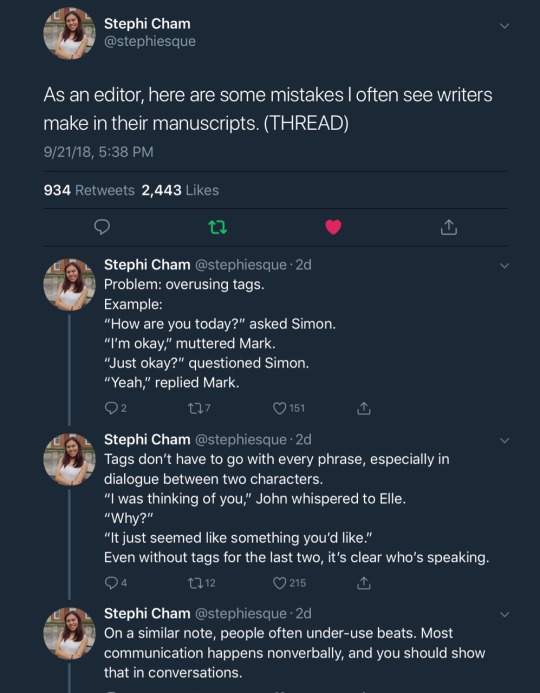
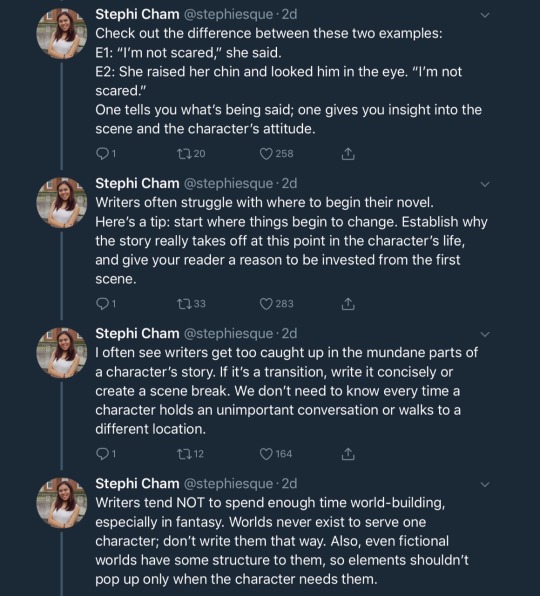
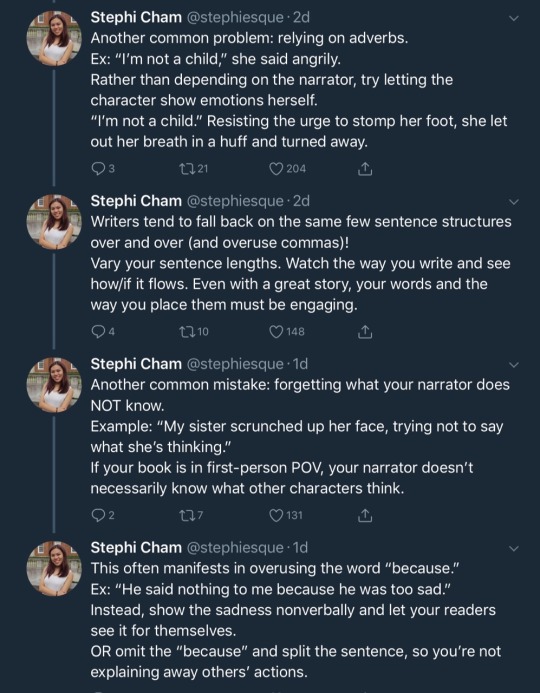
This. This is good fiction writing advice. I really appreciate how it was formatted as “this is a common problem, here is a solution to try in your own work” and not “oh god, don’t do that!” without any extra help. And I extra appreciated the “don’t rely on adverbs” bit, because they do have their place but they aren’t the only way actions can be emphasized.
–– Breaking Bad & Better Call Saul writer, Gennifer Hutchison, constructing *the* best Twitter thread
(….tbh, I’m a little worried she’ll be pissed that I re-posted this on Tumblr, but it’s a good thread and I want to save it. Plus my @name is a PUN and she hatesssss puns… so on many levels she may not be thrilled, so let’s not mention it.)

 Monsters and Stuff