with all demons having a form or another of telepathy, but not Fiendish Creatures, the Abyss may actually be strangely silent and austere, only troubled by the screams of beasts and the fury of the elements, screams of agony and the talk of the few souls sent there… and demons consider mortal so lowly because they speak, like animals and victims rather than even the lowlier demon. But addresses one by telepathy and without a word, and it will treat you like an equal, reacting to you as with a demon without it even realizing its reaction (like how it has been observed in Iraq and Afghanistan that the people there, when talking with US soldiers, will primarily address not the most graded officer but to the one with facial hairs). Demons think lowly of music and musicians, and consider bards barely above insects. Well, wizards, druids and clerics think the same way about bards, but let’s not digress…
What if instead of always having human faces, their head resembles whatever sapient race they were born near (or just take their parents face if they are sufficiently isolated.)
Sort of like how the spider-people aranea have their “disguise” form based on whatever race they “imprinted on” at birth.
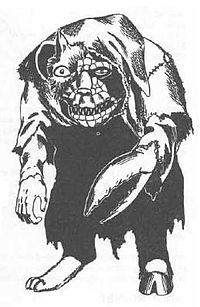
Meet, the “mongrelfolk”, the most racist thing D&D has ever done. Anti-miscagenation propaganda.
However a race of igors that you roll up like a an old style Gamma World Mutant. with a table for each body part would be amazing.
So, heres how to save it:
Change the name
Make them the result of a failed attempt to mass produce a race of shapeshifters to act as spies. (one setting I think did this)
They can work very well along warforged as a concept, a living reminder of a terrible war.
I wouldn’t make them a core race only because they deserve a whole book to themselves.
I do think it would be better for the majority of “good” races to as a whole treat them more with pity and condescension rather than the outright hate they show goblins and orcs.
I’d play up they aren’t actually as pitful as everyone thinks they are and they survive by cooperation and the strength of community bonds. And given how children may look nothing like their parents would also lead to interesting social dynamic.
A young mage meets a traveling practitioner of magic and is fascinated by the person’s familiar. What they don’t realize is its not a normal familiar, but a fiend from the underworld in disguise.
They eventually cast the spell to get their own familiar, and are at first overjoyed it seems the same type as they
But an animal familiar is very much different in personality from a fiend in disguise. Less practiced charm, more simple minded.
So yeah, the dissapointed mage has to learn to appreciate what they have and that a familiar is an entity and not a toy or amusement.
Animal ideas for the familiar
A snake (who instead of being sinister and intellectual preaches the simple pleasures in life like new textures)
A fussy , mothering spider (instead of the cool)
A happy small goat (instead of the regal demon)
I considered rats as a possibility, but they are too charming even if you have high expectations
A frog familiar, considered one of the worst familiars in d&d, was considered but I think would work better as the familiar of a side character who was at first similarly dissapinted while young, but the frog turned out to be very good and finding and collecting material components.(of course this brings up the question if of whether only transactional relationships have any value, which would then have to be explored)
A babbler is an 8′ tall lizard man variant, camouflaged dirty yellow and mottled grey. Like the bonesnapper, it is yet another reason to collect dinosaur toys for your tabletop. (Russ Nicholson, AD&D Fiend Folio, TSR, 1981)



 Monsters and Stuff